Home >
Catalogue >
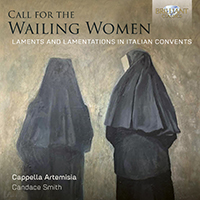
Call for the Wailing Women, Laments and Lamentations in Italian Convents
Call for the Wailing Women, Laments and Lamentations in Italian Convents
Composer
Alessandro Della Ciaia, Agostino Guerrieri, Chiara Margarita Cozzolani, Carlo Donato Cossoni, Giovanni Battista Strata, Giovanni Matteo Asola, Lucrezia Orsina Vizzana, Maria Francesca Nascimbeni
Artist
Cappella Artemisia
Candace Smith artistic direction
Maria Dalia Albertini, Silvia Vajente, Anna Simboli sopranos
Elena Biscuola, Elena Carzaniga, Candace Smith, Chiara Brunello, Marina De Liso, Mya Fracassini mezzo-sopranos
Olivia Centurioni violin
Maria Christina Cleary baroque harp
Claudia Pasetto viola da gamba
Annalisa Pappano lirone
Miranda Aureli organ
Maria Luisa Baldassari harpsichord
Format
1 CD
Cat. number
97603
EAN code
5063758976039
Release
February 2026
Share
Buy online
Download & streams
Other buying options
Buy in
Australia
Fish Fine Music Level 2, Shop 40-42 Queen Victoria Building Sydney CBD +61 (0)2 9264 6458 www.fishfinemusic.com.au
Thomas Music 31 Bourke Street Melbourne, Victoria, 3000 +61 (0)3 9650 9111 www.thomasmusic.net.au
World-premiere recordings of motets by a host of unknown names from the early Italian Baroque: the latest result of performing scholarship by a group with a notable track record of success in this repertoire.
International critics have praised the ‘expert performances’ (Gramophone) of Cappella Artemisia, and the intrepid adventurousness of the ensemble’s founder, Candace Smith, in turning up one buried treasure after another, most of them to be found in the music libraries of Italian convents. The latest fruits of her research have turned up lamentations by Carlo Donato Cossoni, Alessandro Della Ciaia, Giovanni Matteo Asola, Chiara Margarita Cozzolani, Agostino Guerrieri, Lucrezia Orsina Vizzana, Giovanni Battista Strata, Maria Francesca Nascimbeni, Alessandro Della Ciaia – and the best known name among them, Anonymous.
All the pieces here and probably all the composers will be unfamiliar even to those well versed in Baroque-era highways and byways, such as Brilliant Classics has catalogue so comprehensively over the last quarter-century. As Candace Smith observes in her insightful booklet essay, the practice of lamenting - voicing grief - has been associated with women since time immemorial. This album presents a sequence of laments and lamentations from 16th- and 17th-century Italy as they might have been sung in that most exclusively female environment: the convent.
Several of these laments belong to the long tradition of Passiontide compositions to which composers from Gesualdo to Macmillan have contributed, in setting texts from the Book of Lamentations which belong to the liturgy of Maundy Thursday, Good Friday and Holy Saturday. Still other pieces are sacred madrigals setting more contemporary texts, such as O trafitto mio Dio: the work of the 16-year-old Maria Francesca Nascimbeni, before she took the veil.
Musical life was often remarkably rich behind the convent walls. One traveller to Genoa 1592 encountered a young nun who could play the organ, the violin and the lira da gamba, as well as singing beautifully and resembling ‘more an angel than a woman’. Thus this album presents a tiny sample of that culture: one which should entrance listeners on account both of the beauty of the unknown music, as well as the hidden stories behind its composition.
Carlo Donato Cossoni: Morior misera (from Motetti a due e tre voci, Op. 1, Venice 1665, rep. 1678)
Alessandro Della Ciaia: Feria quinta, lamentatione prima (from Lamentationi sagre, e motetti ad una voce col basso continuo, Venice 1650)
Giovanni Matteo Asola: Lamentationes in coena domini (from Lamentationes, Improperia, et alia sacrae Laudes, Venice 1588 in alternation with Anon: Lamentatione di Geremiah (from Canti delle Monache, Bologna 1670)
Chiara Margarita Cozzolani: Quid miseri, quid faciamus? (from Concerti sacri a 1-4 voci, (Op.2, Venice, 1642)
Agostino Guerrieri: Sonata malinconica (from Sonate di Violino [...] Per chiesa, & anco aggionta per camera, Venice 1673)
Lucrezia Orsina Vizzana: Usquequo oblivisceris me in finem? (from componimenti musicali di motteti concertati a una, due, tre e quattro voci..., Venice 1623)
Giovanni Battista Strata: Deh, che fai, anima mia (from Arie di musica [...] per concertare con voci e strumenti, Genoa, 1610)
Maria Francesca Nascimbeni: O trafitto mio dio (from canzoni e madrigali morali, e spirituali. A una, due e tre voci, Ancona 1674)
Anonymous: La Monaca Musica (from ms. MO G239, Biblioteca Estense, Modena)
Alessandro Della Ciaia: Lamentatio virginis in depositione Filij de Cruce (from sacri modulatus ad concentum..., Op. 3, Bologna 1666)