Since the end of the nineteenth century, the large Wagnerian orchestra reached
unprecedented dimensions, pushing listeners’ expectations toward a gigantic sound
overloaded with colour. Mahler continued this tendency, further enlarging the
ensemble: additional winds, triple brass, and a rich percussion section became the
norm. Today we naturally expect overwhelming power from Mahler’s Titan, as
if the very title evoked an immense orchestra. Scogna, by contrast, overturns this
expectation through subtraction: he does not like to speak of arrangement, but
rather of chiselling work. His idea is to reduce excessive doublings while leaving
intact the principal lines chosen by Mahler, almost as if carving from marble only the
contrapuntal skeleton of the work.
Arnold Schoenberg (1918–21) had already theorized a similar idea with the Society
for Private Musical Performances: the aim was to “create a thinned-out sound in
order to examine the essence” of symphonic works.
In transcribing the First Symphony for only fifteen instruments, Scogna carries out a
subtraction of the utmost rigor. Mahler’s commanding orchestra dissolves into a small
chamber ensemble, yet each fundamental timbre remains “typically Mahlerian.”
The result is a revelation, as if hearing Mahler with a new set of ears.
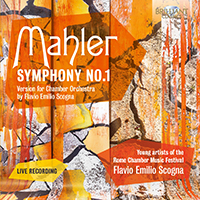
Played by a select group of young Italian instrumentalists, conducted by Flavio Emilio Scogna himself.
Gustav Mahler: Symphony No. 1 (Version for Chamber Orchestra by Flavio Emilio Scogna): I. Langsam, Schleppend, Wie ein Naturlaut
Gustav Mahler: Symphony No. 1 (Version for Chamber Orchestra by Flavio Emilio Scogna): II. Kräftig, bewegt, doch nicht zu schnell. Trio, Recht gemächlich
Gustav Mahler: Symphony No. 1 (Version for Chamber Orchestra by Flavio Emilio Scogna): III. Feierlich und gemessen, ohne zu schleppen
Gustav Mahler: Symphony No. 1 (Version for Chamber Orchestra by Flavio Emilio Scogna): IV. Stürmisch bewegt. Energisch