Alongside Smetana, Dvořák, and Janáček, Bohuslav Martinů stands as one of the great pillars of Czech music. Born in Polička in 1890, he revealed his precocious talent early on, composing his first string quartet at just ten years old. His interest in France and its music, particularly that of Debussy, developed quickly. As a second violinist of the Czech Philharmonic, Martinů also became well acquainted with the works of Ravel and Dukas. In 1923, he moved to Paris, where he studied under Albert Roussel. He would spend the next seventeen years in France, fleeing the German occupation in 1941 to take refuge in the United States. In 1953, he returned to Europe, dividing his time between Nice, Rome, and Switzerland, where he died in 1959.
A composer of vast cultural horizons and innate cosmopolitanism, Martinů’s music reveals a ceaseless curiosity for diverse styles. Though his early work is steeped in Czech folk traditions, his voice soon broadened to incorporate French clarity, the Renaissance English madrigal, and the baroque concerto grosso. Within his vast output, chamber music holds a central place. In 1946, while composing his Sixth String Quartet, Martinů wrote: “In pure chamber music, I always feel most myself.”
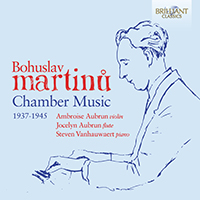
This new recording presents works written between 1937 and 1945: the famous Flute Sonata, Sonata for Flute, Violin & Piano, the Madrigal Sonata for the same instruments, and the Violin Sonata No.3, music of vibrant vitality and rich emotions.
Played with strong commitment by Ambroise Aubrun (violin), Jocelyn Aubrun (flute) and
Steven Vanhauwaert (piano).




&p[url]=http://www.brilliantclassics.comhttps://www.brilliantclassics.com/articles/m/martinů-chamber-music-1937-1945/&p[images][0]=http://www.brilliantclassics.nl/covers/5063758975018.jpg)