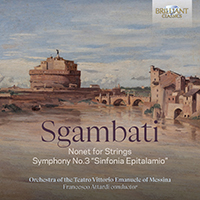
Born in Rome, to an Italian father and an English mother, Giovanni Sgambati (1841-1914), received his early education at Trevi, in Umbria. In his early twenties he met Franz Liszt in Rome, where the great composer resided for a period each year from 1861. The young man immediately became his favorite pupil, a faithful interpreter of his compositions and a precious collaborator for the mission that warmed both their hearts: to spread classical music in the Roman society of the time. Liszt's Roman school was based in Sgambati's home, where the master trained the best pianists of the time. Sgambati was the first to conduct his Dante Symphony. Liszt took him with him on his travels and introduced him to Richard Wagner, who deeply admired his compositions. His fame grew rapidly, leading him to give concerts all over Europe and in Russia. He received invitations and signs of esteem from the most important musicians of his time: in addition to Liszt and Wagner, he was friends with Brahms, Tchaikovsky, Grieg, Massenet and Busoni.
The Nonetto written for nine string instruments, composed between 1866 and 1867 by the young Sgambati, was not published because the composer himself considered it too difficult, almost unplayable for the time in Italy. The composition is in an experimental form not comparable to the sonata form, but it comes close to the idea of the Lisztian ‘cyclical form’, with recurring episodes and themes, with a masterful use of counterpoint.
Sgambati’s Symphony No. 3, “Epitalamio” (1888) is a festive orchestral work composed to celebrate the marriage of Prince Amedeo of Savoy and Princess Laetitia Bonaparte. Written between 1886 and 1888, the symphony reflects the grandeur and elegance of a royal wedding, moving through scenes set in a church, a garden, and a court. Structured in three parts with five sections, it combines solemn hymns, lyrical nocturnal episodes, lively dances, and ceremonial processions. Influenced by the symphonic traditions of Liszt and Wagner.
Played by top Italian string soloists and the Orchestra of the Teatro Vittorio Emanuele di Messina, conducted by Francesco Attardi.
Giovanni Sgambati: Nonetto per archi (1866): I. Andantino con moto – Allegro moderato - Più mosso – Allegretto moderato
Giovanni Sgambati: Nonetto per archi (1866): II. Adagio - Allegro giusto
Giovanni Sgambati: Nonetto per archi (1866): III. Andante con moto - Un poco più mosso - Più mosso – Largo – Allegro moderato - Allegro vivace, quasi Presto - Tranquillo assai (un poco meno) Un poco meno vivace - Allegro vivace, quasi presto
Giovanni Sgambati: Symphony No. 3 ‘Epitalamio’ (1888), Pt. I. In the Church: I. Prelude and Cantique
Giovanni Sgambati: Symphony No. 3, Pt. II. In the Garden: I. Popular Festival and Nocturne
Giovanni Sgambati: Symphony No. 3, Pt. II. In the Garden: II. Reprise and Children Mayhem
Giovanni Sgambati: Symphony No. 3, Pt. III. In the Courtyard: I. Minuetto
Giovanni Sgambati: Symphony No. 3, Pt. III. In the Courtyard: II. Cortege