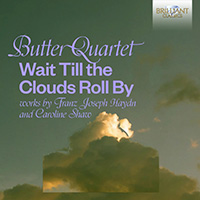
Preparing a quartet turns abstract notes into a living, breathing musi-cal world. Working on Haydn’s Op. 77 and Shaw’s Entr’acte felt like stepping through Alice’s looking glass, where past and present meet. Performing both works on gut strings and classi-cal bows created a shared expressive language across centuries.
Shaw’s piece, inspired by Haydn’s sudden shift to D flat major, plays with surreal transitions and rich, woody textu-res. Haydn’s quartets, though few in number, reveal clarity, lyricism, and daring rhythmic exploration. Historical editions opened new inter-pretive possibilities, reminding us that each performance captures only one moment in an evolving tradition. Together, these works form portals into contrasting eras, emotions, and perspectives.
Preparing a quartet transforms notes and structures from something abstract into a vivid, living form. As we shaped Haydn’s String Quartets Op. 77 and Caroline Shaw’s Entr’acte, Alice’s Looking Glass became a fitting metap-hor—a portal through which past and present coexist. As a historically informed quartet, we study how older works first resonated with audiences while approaching new compositions with the same curiosity. Playing both Haydn and Shaw on gut strings and classical bows allows a shared expressive language across centuries. Shaw’s Entr’acte was directly inspired by Haydn’s Op. 77 No. 2, especially its unexpected shift to D-flat major. Structured like a minuet and trio, her piece explores playful, surreal transitions that feel like stepping through the looking glass.
We relished discovering how harmonics, extended techniques, and historical bows create woody, textured colors unique to gut strings. The constantly shifting meters and the pavane-like middle section offered fu-rther opportunities for imaginative sha-ping. Haydn’s Op. 77, though influenti-al, is his shortest quartet collection. Commissioned as six quartets, only two were completed. We open Wait Till the Clouds Roll By with the second quartet in F major. Its first movement balances clarity with a misty, exploratory development. The Menuet feels rhythmically unstable before dissolving into the dreamy Trio.
The Andante’s serene theme and variations momentarily suspend time before the Finale jolts us awake. In working with historical editions—full of contradictions—we embrace the interpretive possibilities they offer, knowing a recording captures only one moment in an evolving tradition.
In the G major quartet, a static yet expectant opening gives way to fragmented, lively exchanges.
The Adagio offers spaciousness and sublime calm. Haydn’s virtuosic Presto movements inspired us to experiment with tempo, including the daring 1854 metronome markings by Karol Lipiński.
The Butter Quartet consists of four musicians brought together by their mutual love of vibrant historically-informed performance of string quartets. They first formed during their studies at the Royal Conservatory of The Hague, but soon developed a passion and dynamic that extended beyond their conservatory years. They released their debut album ‘Scintilla’ in July 2024 with Brilliant Classics. The Butter Quartet enjoys integrating their research on late 18th-and early 19th-century performance practice into powerful performances. They also bring the same spirit of discovery to newly-composed works for historically-setup instruments.
Butter Quartet: ‘‘Wait Till the Clouds Roll By’’ reflects our belief that music, like Alice’s journey, helps us navigate a world of beauty, confusion, humor, and transformation. Through Franz Joseph Haydn (1732-1809) and Caroline Shaw (b.1982), we experience portals between eras, emoti-ons, and perspectives.